Posts

Featured Post

Efficient Duplicate Image Removal: Using ImageDeDup Python

Efficient Duplicate Image Removal: A Python Guide In this blog post, we will walk you through the process of identifying and removing duplicate images from your directories using Python. We will leverage perceptual hashing to find similar images and delete duplicates while keeping the largest file in the group. This solution is perfect for users who want to save disk space and keep their image collections organized. Why You Should Use This Code Over time, especially when dealing with large collections of images, duplicate files can accumulate. These duplicates take up unnecessary space on your system. Manually sifting through these images can be tedious, but with the help of Python, perceptual hashing, and concurrent processing, this task becomes much easier. Benefits: Efficient Duplicate Detection : By using perceptual hashing (PHash), the code compares images based on their v...

Phenomenons related to individual performance

Image
Individual performance Social Loafing (Ringelmann effect) is a concept that describes that people are prone to put in less effort in a team rather than when working individually. Ringelmann made an experiment with a large group of people pulling the rope. The bigger the group, the less effort every participant will put in. There are many reasons to lack motivation while working in a team: Social Loafing Free-rider-effect – some people may just lay back knowing that others will do the work, hiding back their ideas and actions thinking that others are stronger and better and can get the job done better. Having one free-rider in the team may affect the motivation of all the members. If this happens repeatedly, others can get a feel of being exploited and unsatisfied. The Sucker Effect – when one of the team members refuses to do the work and leaves from the team. He leaves the team because he doesn’t want to be the sucker. How to avoid social loafing: -    ...

System interface questions for requirement elicitation - Business analyst/System analyst

Image
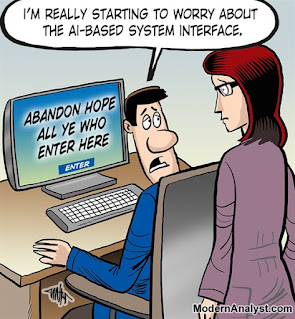
Generic overview of questions to ask for the specification of an interface (between a system A and a system B) – Business Analyst/System Analyst   Ø Business Requirement Questions 1.      What kind of interface do you need unidirectional or bidirectional Unidirectional interface: The data will be sent in one direction by the sender to the receiver. Ex: System A sends data to System B and the receiver System B will read, process, write and store the data. In the case of bidirectional the systems are connected such that data can be sent and received by both. Ex: System A and System B can both read, process, write, and store the data within each other. 2.      What do you want to achieve with this interface? The business needs this interface to help to fulfill and provide support. 3.      The Actions Needed by you in the interface? The data is required to be Deleted (DELETE), Overridden and created (PUT), O...

Consultant - Understanding the Job

Image
What does the consultant do? Solve Business Problem. But, it is very deep term. Management Consultant is content ambassador. They are the bridge between complex client context and massive knowledge with experts. They are also responsible for the network stream. In the case of cement plant - should the client close the plant? As a consultant from McKinsey, I need to find it. As a consultant, you analyze a problem and break it into smaller parts. So, for the above problem, we would try exploring ways to improve sales and cut costs. Ex: To cut costs may be logistics is the biggest factor, so as a consultant we talk to logistic partners of the company. Duties of a consultant as a content ambassador? (Very Important) -           Gather content - research internal databases, research internet, study reports by independent parties, interview experts, interview clients, interview customers, mystery shopping, data analyzing, survey...

Working with docker

Image
Docker Image :  Building a Docker Image  by docker file – includes the build and all the dependencies,  Container : Running the created docker image as a container on the Docker by using run command.  Docker Daemon – The background application which manages building, running and distributing docker containers. Docker Client – The command line tool that helps to interact with docker daemon. Docker Hub : It is a registry(repository) of Docker Images similar to github repositories of branches and projectes. Hence, once a image is build, it can be pushed to the docker hub and can be pulled and run as a container. docker build -t rishoo2019/cheers2019 . docker run -it --rm rishoo2019/cheers2019 docker pull docker images – Displays all the container images present on the docker docker ps = Displays all the containers currently running docker ps -a = Displays all the containers that we ran, also there remanents docker run -it busybox sh Running the ru...

Working with Git Repositories Using GitHub Desktop

Image
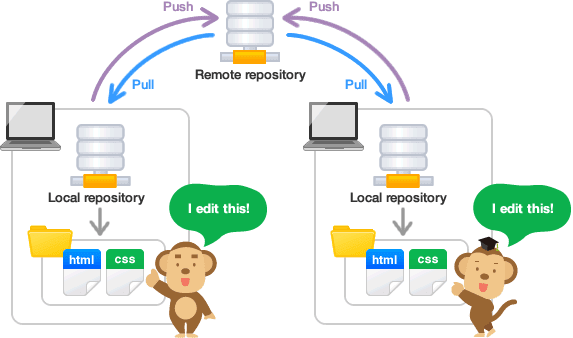
Using GitHub Desktop Clone GitHub repository Open the GitHub Desktop application. In the file menu select clone repository. The popup modal displays the list of repositories accessible in your GitHub. Select the repository and click clone. The desktop application gives you an option to open the cloned repository in VS Code. Read More . Pull GitHub Repository (GitHub Desktop) Inside GitHub desktop to pull the changes from the origin, we set the "Current repository" to GitHub repository we want to pull changes from. Then we set the "Current branch" to "master" or else set the current branch to any specific branch we want to pull the changes from. After selecting the appropriate "Current repository" and "Current branch" we now click “Fetch Origin”. Then after the Origin Fetch has completed we go into the "repository" option in the main menu and click "Pull". This will pull the n...

Opting classic row modeling or EAV data modeling?

Few of the circumstances are listed below where EAV scores over conventional tables: ·          The data type of individual attributes varies. Like in above example EAV is used because the requirements vary from client to client like some may want an extra address like added to existing address format. ·          The categories of data are numerous, growing or fluctuating, but the number of instances (records/rows) within each category is very small. Here, with conventional modeling, the database’s Entity-Relationship Diagram might have hundreds of tables: the tables that contain thousands/ millions of rows/instances are emphasized visually to the same extent as those with very few rows. The latter are candidates for conversion to an EAV representation. Other Related Links: EAV(Entity-Attribute Value) Model EAV versus Row modeling Downsides of EAV data model over class row model Optin...

Downsides of EAV data model over class row model

Flabbiness : Flexibility is great with EAV, but there will be no structure any longer. Typically, the reliability on the built-in database features such as referential integrity is lost. To guarantee that a column takes values only in acceptable range, integrity check needs to be coded inside the application . Inefficient queries:  In cases where one would be required to execute a simple query returning 20 columns from a single table in classic row modeling technique, in EAV one ends up with 20 self-joins, one for each column. It makes for illegible code and dreadful performance as volumes grow .  Features unavailability : Much of the machinery of modern relational databases will be unavailable and will need to be recreated by the development team. For e.g. System tables, graphic query tools, fine grained data security etc. Other standard tools are much less useful :  Cursors in database functions do not return rows of user data since the data must first...